



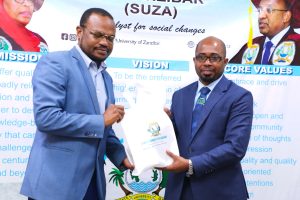

The State University of Zanzibar (SUZA) and the Zanzibar Research Centre for Socio-Economic and Policy Analysis (ZRPC) have officially signed a Memorandum of Understanding (MoU) aimed at strengthening collaboration in research, innovation, education, and community development.
The signing ceremony took place on 28th May, 2026 at the Conference Hall of the Administration Building, Tunguu Campus, and was attended by leaders and officials from both institutions.
Speaking during the event, Prof. Abdi Talib Abdallah, Acting Vice Chancellor of SUZA, expressed appreciation to ZRPC for supporting the university’s vision and mission.
“On behalf of the University, we are pleased and thankful for your support. We are now moving towards challenge-driven research aimed at solving citizens’ problems. We have been engaging government institutions to trust us and provide opportunities for such work,” he said.
Prof. Abdi noted that the partnership will support the implementation of research projects, preparation of joint proposals, and mobilization of funds to enable researchers to conduct impactful studies.
He also emphasized the importance of collaboration in innovation activities at the Maruhubi Innovation Hub, which SUZA expects to officially launch soon. In addition, he encouraged cooperation in organizing and managing events, especially major conferences capable of attracting public and international attention.
“We should appoint coordinators to oversee this collaboration and hold regular evaluation meetings. We expect great achievements from this MoU because our country needs us,” Prof. Abdi added.
On his part, Dr. Twahir Khalfan, Executive Director of ZRPC, thanked SUZA for accepting the partnership and described the collaboration as a significant opportunity for both institutions.
“We are working together with SUZA experts, and many SUZA students will benefit from this partnership. It is a win-win situation. As an institution close to industry and innovation, we believe this collaboration will bring SUZA closer to industries and the wider community,” said Dr. Twahir.
He explained that the partnership will focus on two major areas: research and youth development. According to Dr. Twahir, the collaboration will also support initiatives in early childhood education, internships, conferences, and joint research projects, while contributing to community development through the use of technology.
The partnership is expected to enhance research capacity, innovation, academic cooperation, and practical solutions to societal challenges in Zanzibar and beyond.